I was only a child when the Great War broke out in
1914, but I had already begun to perceive and comprehend. The first thing that
suddenly occurred to me, having witnessed, felt and actually experienced the
affliction of my people, was this question: What was it that brought all this
woe on my people?
Soon after the end of the war, I began to look for
an answer to this question and a solution to this chronic political problem
which seems to drive my people from one adversity into another, constantly
delivering it from a lesser evil to make it an easy prey to a greater one. It
then happened that I left the country in 1920 while dormant sectarian rancours
were still widespread and the nation had not fully buried its corpses.
The situation in the diaspora was only a little
better. Various tendentious movements had had their effects and badly
factionalised the community. Although they were all Syrians, a sizeable group
among them had yielded to extreme inter-sectarian hatred, so that, a Lebanese
patriotism concept arose in turn, which is itself also an outgrowth of the
leadership of religious institutions and of their authority and influence [in
society].
Obviously, I was not seeking an answer to the
above-stated question for the mere purpose of satisfying a scientific or
intellectual curiosity. For a scientific knowledge which does not benefit is no
better than a harmless ignorance. Rather I sought an answer to that question
purely for the purpose of determining the most effective way to eradicate the
causes of that woe. After a preliminary systematic inquiry I came to the
conclusion that the loss of national sove-reignty was the primary cause of my
nation's past and present woes. This led me to pursue the study of nationalism,
the question of communities in general, and of the issue of social justice and
its evolution. In the course of my inquiry and research I became keenly aware
of the importance of the idea of a nation, its meaning, and the complexity of
the factors from which it emanates. It was on this issue that my line of
thinking became completely distinct from those of all others who became
profoundly pre-occupied with the political life of my country and its national
problems. They worked for freedom and independence in an abstract manner which
took their pre-occupation outside the national endeavour in its correct sense,
whereas I wanted the freedom of my country and the inde-pendence of my people
in it. The difference between this better-focused conception and the previous
ambiguous and highly abstract conception is clear. I tried with all the Syrian
political parties and associations that I happened to join, or form, or have
contact with, to direct their thinking towards the insights that I had myself
gained, but I did not have too much success in this regard.
Even a contrast with the ideas of the political
bosses would help make my own position clearer, in the sense that my position
became more and more founded on a national basis, whereas their stances had
been and continued to be determined by political pragmatism. Politics for the
sake of politics could not possibly constitute a national act.
Accordingly, and in view of the fact that a
comprehensive national endeavor dealing with the question of national
sovereignty and the meaning of the nation, could not be emptied of its
political contents, I decided to enter the political field by following the
path of a new social nationalist renaissance that would guarantee the
purification of the existing nationalist beliefs and their unification into a
single ideology and would, in turn, foster the kind of solidarity (Esprit de
Corps) which is essential for national co-operation, progress, and the
protection of the national interest and rights.
After I was able to determine my nation on the basis
of modern science, which forms the cornerstone of every national construction,
and to establish the social and political interest of this nation in the
aspects of its internal situation and its external and internal problems
through the social, political and economic inquiries which I undertook, I
realized that I would then have to devise means that would protect the new
social nationalist renaissance as it surged ahead. It was this that first
suggested to me the idea of forming a secret political party that would
initially incorporate those forces of our youth that stand out for their
integrity and lack of affection for the corruptions of debased politics. So I
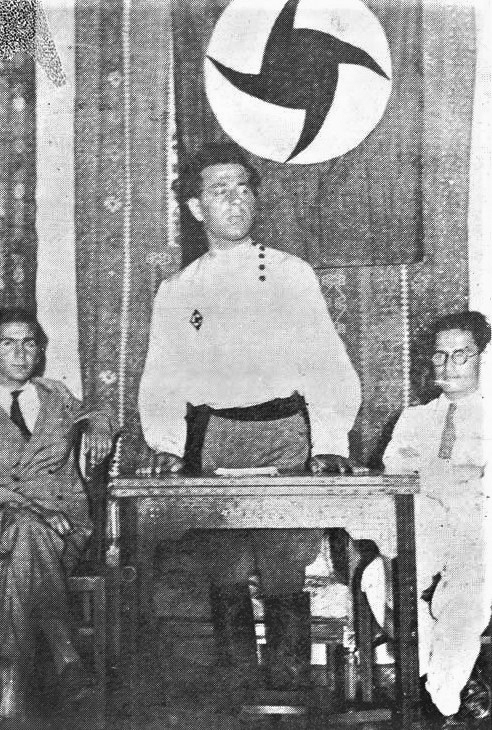
founded the Syrian Social Natio-nalist Party and I unified the various
nationalist beliefs into the one idea namely Syria is for the Syrians and the
Syrians are one nation. I also laid down a number of reform principles, namely,
the separation of religion from the state, turning production into an
infrastructure for the distribution of wealth and labour, and the establishment
of a strong army that can play an effective role in determining the destiny of
the nation and the homeland. Furthermore, I adopted a clandestine formate for
the party to shield it from the onslaught of the various factions in society
which dreaded its creation and growth, and the authorities which would not
desire such a party to exist. I then organized the party on a central
hierarchical basis and in the fashion that focuses on the quality of each
recruit in order to prevent internal confusion, and to avoid all forms of
factionalism, destructive competition, and other social and political ailments,
as well as to foster the virtues of discipline and duty.
I laid all of this down and went ahead with founding
the party in total disregard of the existence or non-existence of the mandate.
Thus, the party was not founded exclusively as a counterweight to the mandate,
but to unify the Syrian nation into a sovereign state that has the will to
determine its own destiny. Since the mandate was only a passing phase,
calculating its position and the party's attitude toward it is a purely
secondary political consideration. The party was not founded on the principle of
foreigner hatred or chauvinism, but on the principle of social nationalism. The
mandate may have temporarily boosted the popularity of the party and
strengthened the motives to create it, but it remains a subordinate issue which
has limited importance.
At
any rate, the national question, by its very nature, would inevitably have to
come to grip with the conflict of survival between national sovereignty and
mandatory rule.
